Employment and Job Market in Cameroon Explained – Jobs, Salaries & Reality
Employment and job market in Cameroon explained properly requires understanding that opportunities exist across both formal and informal sectors. Employment and job market in Cameroon explained is not limited to office jobs — it includes small businesses, freelance work, agriculture, and informal services.
Many people combine multiple income sources, and job stability often depends on sector, skill level, and location.
This guide explains how employment actually works on the ground.
Understanding Employment and Job Market in Cameroon Explained
When discussing employment and job market in Cameroon explained, we must look at:
- Formal employment (offices, companies, government)
- Informal work (small businesses, daily income activities)
- Self-employment
- Freelance and digital work
The labour market is diverse but also competitive, especially for young graduates.
For broader economic context:
→ Doing Business in Cameroon Explained
Formal Employment Opportunities
Formal jobs are typically found in:
- Government institutions
- Banks and financial services
- Telecommunications companies
- NGOs and international organisations
- Large private companies
Examples:
A university graduate in Yaoundé may secure a job in a bank or government office after competitive application processes.
However:
- Job openings may be limited
- Recruitment may take time
- Competition is often high
Informal Employment Reality
A large part of employment happens outside formal systems.
Examples:
- A young man operating a motorbike taxi
- A woman running a small food business
- A trader selling clothes in the market
- A phone repair technician
These jobs may not offer fixed salaries but provide daily income.
For deeper understanding:
→ Informal Economy in Cameroon Explained
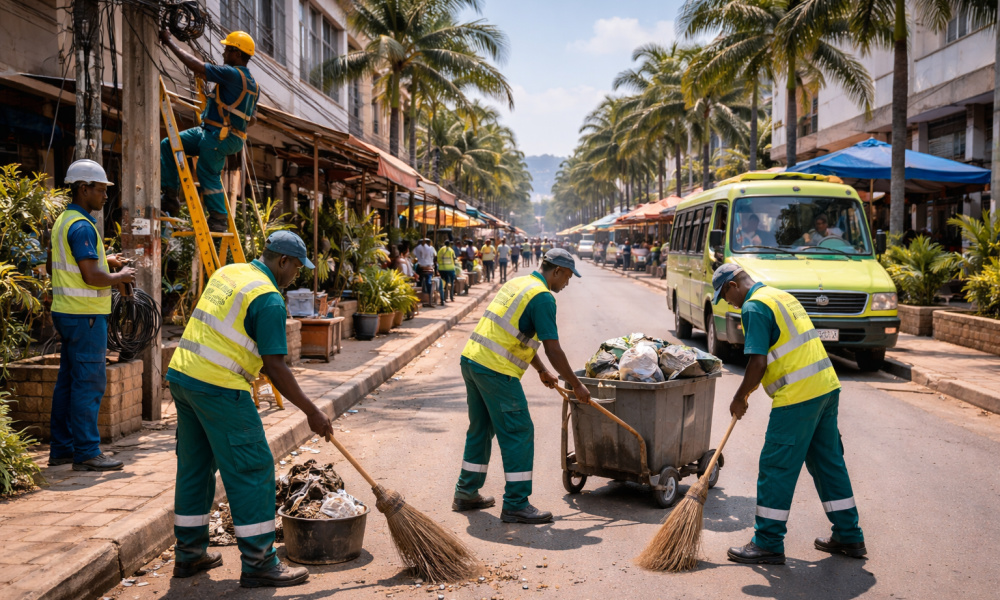
 Cameroon has a young, vibrant urban job market
Youth Employment Challenges
Cameroon has a young population, which creates both opportunity and pressure.
Challenges include:
- Limited formal job openings
- High number of graduates
- Skills mismatch in some sectors
Example:
A graduate in economics may struggle to find a formal job and instead start a small business or freelance activity.
Adaptability becomes essential.
Salaries and Income Levels
Salaries vary widely depending on sector.
Formal jobs may offer:
- Monthly salary
- Structured work schedule
- Some job security
Informal work may offer:
- Daily income
- Flexible hours
- Variable earnings
Example:
A bank employee may earn a fixed monthly salary, while a trader may earn more or less depending on sales.
For cost context:
→ Cost of Living in Cameroon Explained
Self-Employment and Entrepreneurship
Many people create their own jobs.
Examples:
- Opening a small shop
- Starting a transport service
- Running an online business
- Providing local services
Self-employment is often the fastest way to generate income.
For practical guide:
→ Starting a Small Business in Cameroon Explained
 Thousands of small businesses exist in Cameroon
Job Search Methods
Finding a job often involves:
- Personal networks
- Referrals
- Online job platforms
- Direct company applications
Connections can play an important role.
Example:
A job seeker may learn about an opportunity through a friend rather than a public advertisement.
Work Culture and Expectations
Work culture may vary depending on sector.
Common characteristics include:
- Respect for hierarchy
- Flexible time expectations in some environments
- Emphasis on relationships
Professional environments may differ between:
- Government offices
- Private companies
- Small businesses
For cultural context:
→ Cameroon Culture and Society
Urban vs Rural Employment
Urban areas offer:
- More job opportunities
- Greater business activity
- Higher competition
Rural areas offer:
- Agricultural work
- Smaller-scale business
- Community-based employment
Both environments require adaptation.
Common Misunderstandings
Common misconceptions include:
- “There are no jobs at all”
- “Only government jobs matter”
- “Success is impossible”
Reality:
Opportunities exist, but often require:
- Flexibility
- Initiative
- Multiple income streams
Why Employment and Job Market in Cameroon Explained Matters
Understanding employment and job market in Cameroon explained helps:
- Job seekers plan realistically
- Diaspora prepare for return
- Investors understand labour dynamics
- Students choose career paths
Clear expectations improve outcomes. You are fully equipped.
 A little glimpse of a Cameroon Urban office environment.
External Reference
For labour and economic data:
Part of the Business & Survival Guide
This article on employment and job market in Cameroon explained is part of the broader Business section.
Related guides:
→ Doing Business in Cameroon Explained
→ Informal Economy in Cameroon Explained
→ Starting a Small Business in Cameroon Explained
→ Investment Risks in Cameroon Explained
Final Perspective
Employment and job market in Cameroon explained reveals a system that combines formal jobs, informal work, and entrepreneurship.
Success often depends on adaptability, relationships, and practical decision-making.
Understanding how the job market works allows better planning and more realistic expectations. We hope we have provided you with all the necessary knowledge you need to navigate this very important area of life in Cameroon.
Do not hesitate to share your opinions and experience, while you lived in Cameroon.