Cameroon Travel Warnings Explained: What They Mean & How to Travel Safely
This cameroon travel warnings explained guide helps you understand what official travel warnings actually mean—and how to interpret them realistically.
Many travellers see strong warnings and assume the entire country is unsafe. Others ignore them completely. Both approaches can lead to poor decisions.
This guide explains how to read travel warnings properly, understand the real risks, and make informed travel choices.
ravel warnings are issued by governments such as:
- UK Foreign Office
- US State Department
- Canadian travel advisory
They are designed to:
- Inform citizens
- Reduce risk
- Provide guidance
👉 Important: They are risk-avoidance tools, not travel guides.
The Anatomy of a Travel Warning
Official advisories from the U.S. State Department or the UK Foreign Office are designed to protect citizens from the worst-case scenario. In 2026, Cameroon is typically categorized under a "Level 3: Reconsider Travel" or "Level 4: Do Not Travel" status. However, a country as geographically and culturally diverse as Cameroon cannot be painted with a single brush.
The "Zone" System
To understand the warnings, you must divide the country into three distinct risk zones:
- Green Zones (Stable): Much of the Adamawa (Ngaoundere), West (Bafoussam), Center (Yaoundé), and Littoral (Douala) regions. Here, the warnings about "crime" are similar to those for major European or American cities.
- Yellow Zones (Cautionary): Areas bordering the East and South, where cross-border activity requires heightened awareness but remains navigable for the prepared traveler.
- Red Zones (High Risk): The Far North (Boko Haram) and the Northwest/Southwest (Anglophone Crisis). Travel here is genuinely dangerous for outsiders and is where the bulk of the "Do Not Travel" warnings originate.
Why Travel Warnings Can Seem Extreme
One key point in this Cameroon travel warnings explained guide:
👉 Governments often apply broad warnings to avoid liability.
This means:
- Entire regions may be labelled “high risk”
- Even if some areas are stable
Example:
- A region may have localized issues
- But the entire region receives the same warning
👉 This creates confusion.
How to Read Cameroon Travel Warnings Correctly
Instead of reacting emotionally, break warnings into:
1. Geographic Scope
Ask:
- Which regions are affected?
- Are major cities included?
2. Type of Risk
Is the warning about:
- Crime?
- Conflict?
- Infrastructure?
👉 Not all risks are equal.
3. Timing
Some warnings are:
- Temporary
- Situation-based
👉 Always check current context.
Real vs Perceived Risk
This Cameroon travel warnings explained guide helps separate:
Perceived Risk:
- Headlines
- General statements
- Broad warnings
Real Risk:
- Specific locations
- Specific situations
- Behaviour-based exposure
👉 Real risk is usually more localised.
Safer Travel Strategies
Instead of avoiding Cameroon entirely, use structured approaches:
Focus on Stable Cities
Safer options include:
- Yaoundé
- Douala
- Buea
- Limbe
- Bafoussam
Avoid High-Risk Zones
- Far North conflict areas
- Sensitive regions without guidance
Plan Movement Carefully
- Travel during daytime
- Use trusted transport
- Stay in known areas
Common Mistakes Travellers Make
Mistake 1: Ignoring All Warnings
👉 Leads to unnecessary risk
Mistake 2: Avoiding Entire Country
👉 Leads to missed opportunities
Mistake 3: Poor Planning
👉 Most common cause of problems
👉 Balanced understanding is key.
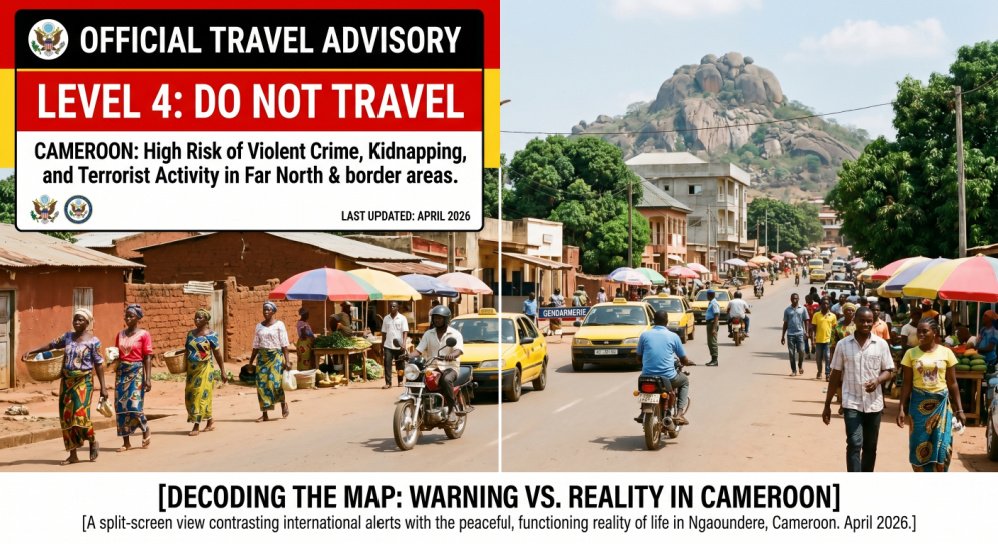 Real vs perceived Risks
My Personal Experience
Deciphering travel warnings for Cameroon requires looking beyond the "red zones" to understand the nuanced reality of life on the ground. Having lived across this diverse tapestry for over thirty years—from sprawling urban centers to the quietest remote villages—I have seen how perception and reality often diverge. While official reports serve as a necessary map of potential risks, they are not the territory itself. In everyday life, many areas categorized as "risky" function with a predictable, manageable normalcy.
The most critical factor in your security isn't a high-tech lock or a specialized insurance policy; it is awareness. Travel warnings are only useful when you understand the context behind them—knowing where to go, when to move, and how to carry yourself. My journey has taught me that in Cameroon, relationships are your real armor. Whether I was navigating a breakdown near Vina Falls at dusk or walking through the markets of Douala, I relied on the "Patience and Respect" rule. By approaching a local village head or a Lamido’s guard with humility and a "warm" handshake, I consistently found sanctuary where an "arrogant tourist" might find friction.
Cameroon is not a place to fear by default; it is a place that becomes difficult only when it is misunderstood. If you move with intentionality, listen to local advice, and choose to walk as a respectful guest, you unlock a level of safety that no advisory can quantify. Awareness isn't just a survival tip—it is the key to experiencing the true heart of the Motherland.
👉 One key insight:
Travel warnings are useful—but only when you understand what they actually mean.
Who This Guide Is For?
This cameroon travel warnings explained guide helps:
- First-time visitors
- Diaspora travellers
- Researchers
- Foreign professionals
Why This Guide Matters
This page helps you:
- Understand official warnings
- Avoid unnecessary fear
- Travel more intelligently
Share This Page
Join the Journey
Stay Updated
Get updates on:
- Travel conditions
- Safety insights
- Practical advice
Cameroon Travel Warnings Explained: Explore More
Explore More
- → Safety and Common Risks in Cameroon
- → Is Cameroon Safe to Visit
- → Cameroon Travel Guide
- → Cities & Regions Guide
For external reference
Final Perspective
As we conclude this exploration of Cameroon Travel Warnings Explained, the ultimate takeaway is that Cameroon is not "dangerous" by default. It only becomes difficult when it is misunderstood. If you choose to walk as a "respectful guest" rather than an outsider, you unlock a level of security that gates and guards can never provide.
The warnings you see online are a map of potential risks, but they are not the territory itself. They are tools for preparation, not barriers to experience. By staying informed, respecting local customs, and maintaining a high level of situational awareness, you can navigate the "hinge of Africa" safely. Understand that your experience is largely dictated by your own conduct; awareness isn't just a safety tip—it’s the key to the heart of the country.
This Cameroon travel warnings explained guide shows that warnings are not the final answer—they are the starting point.
👉 The goal is not to avoid travel, but to travel intelligently.