💼 How to Start a Business in Cameroon: Step-by-Step Practical Guide
Starting a business can be rewarding—but only if you understand the environment properly. This How to Start a Business in Cameroon guide explains how to start a business in Cameroon in a practical, realistic, and structured way—covering registration, costs, systems, risks, and real-life expectations.
👉 This is not theory.
👉 This is how things actually work.
🧭 Understanding the Business Environment
Before starting, you must understand one key reality:
👉 Cameroon operates through both formal and informal systems.
This means:
- Legal registration is important
- Relationships are equally important
- Processes may not always follow strict timelines
👉 Success depends on adaptation, not resistance.
🧱 Step 1: Choose the Right Type of Business
Start by defining:
- What you want to sell
- Who your customers are
- Where you will operate
Common business areas include:
- Retail and trading
- Agriculture
- Transport services
- Food and hospitality
- Digital services
👉 Avoid copying trends. Focus on local demand.
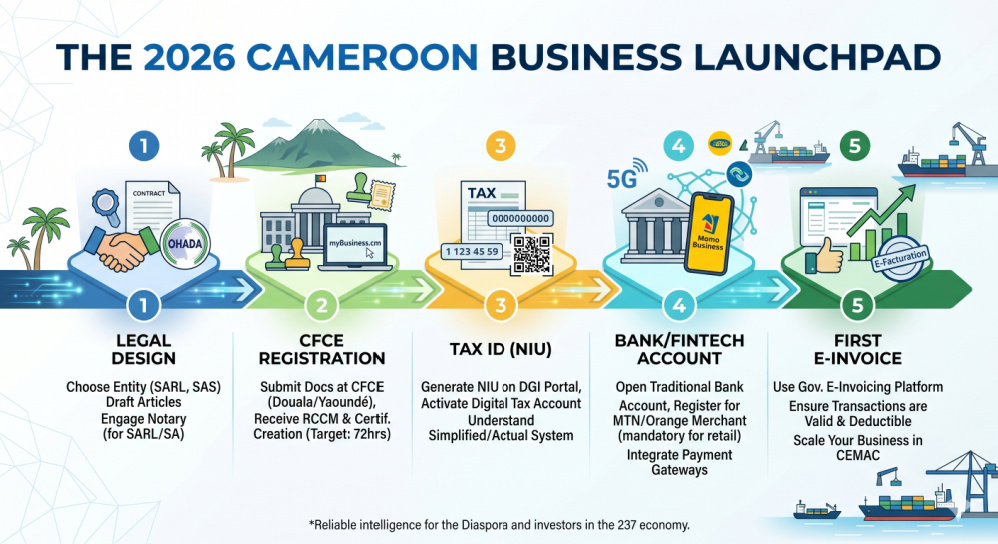
1b. Choosing Your Legal Structure (OHADA Standards)
Cameroon is a member of OHADA (Organization for the Harmonization of Business Law in Africa). This means your business structure must comply with regional standards.
- Sole Proprietorship (Établissement): Best for small-scale traders. You and the business are one legal entity.
- SARL (Société à Responsabilité Limitée): The most common choice for SMEs. Minimum capital is now flexible (theoretically 100,000 XAF, but check your specific sector). Requires a Notary.
- SA (Société Anonyme): For large-scale ventures. Requires a minimum capital of 10,000,000 XAF and a board of directors.
- SAS (Société par Actions Simplifiée): A newer, more flexible structure favoured by tech startups in 2026 for its ease of share transfer.
📝 Step 2: Register Your Business
In Cameroon, business registration is done through One-Stop Shops (CFCE):
👉 Centre de Formalités de Création d’Entreprises
These centers help you:Typical requirements:
- Register your company
- Obtain a taxpayer number
- Get legal documentation
- ID or passport
- Business name
- Address
- Initial capital (varies)
👉 Registration can take a few days to a few weeks depending on efficiency.
💰 Step 3: Understand Startup Costs
Costs vary widely.
Typical expenses include:
- Registration fees
- Rent (if applicable)
- Equipment or stock
- Operational cash
👉 A small business may start with a few hundred euros
👉 Larger ventures require more planning
For cost context:
→ See Cost of Living in Cameroon
→ See Cost of Traveling to Cameroon
🏦 Step 4: Open a Business Bank Account
While traditional banks like Afriland First Bank or SG Cameroon are necessary for large credit lines, 2026 has seen a surge in Fintech Business Accounts.
- Mobile Money for Business: Registering for an "Orange Money" or "MTN MoMo" Merchant account is mandatory for any retail or service business.
- B2B Fintechs: Platforms like Campay or Smobilpay allow you to integrate local payments into your website or shop instantly.
You will need:
- Business registration documents
- Identification
- Address details
👉 However, note:
Many transactions still occur outside formal banking systems.
📊 Step 5: Understand Taxes and Compliance
Businesses must comply with:
- Tax registration
- Periodic declarations
- Licensing (depending on activity)
You can consult:
👉 Direction Générale des Impôts Cameroun
👉 Keep records—even if operations are small.
Under the 2026 Finance Law, you cannot operate legally without a Digital Tax ID (NIU - Numéro d’Identifiant Unique).
- Tax Systems: Most new businesses fall under the Simplified System or the Actual System based on turnover.
- E-Facturation: All B2B transactions must now use the government’s digital invoicing platform. Failure to do so makes your expenses non-deductible for tax purposes.
6. Labor Laws and Social Security (CNPS)
If you hire staff, you must register them with the CNPS (Caisse Nationale de Prévoyance Sociale) within 8 days of hiring.
- Contracts: Ensure you use written contracts. In Cameroon, a "verbal agreement" is legally interpreted in favour of the employee during disputes.
🤝 Step 7: Build Local Relationships
This is where many people fail.
In Cameroon:
- Trust matters
- Networks matter
- People matter
You need:
- Reliable suppliers
- Local advice
- Community trust
👉 A strong network can solve problems faster than paperwork.
⚠️ Step 8: Understand Real Risks
Starting a business comes with risks:
Operational risks:
- Delays
- Supply issues
- Power/infrastructure challenges
Financial risks:
- Poor planning
- Cash flow issues
Social risks:
- Pressure from family/community
- Informal expectations
👉 Awareness reduces risk.
📈 Step 9: Start Small, Then Scale
One of the biggest mistakes on How to Start a Business in Cameroon is starting too big.
Instead:
- Test your idea
- Learn the environment
- Adjust gradually
👉 Growth should follow understanding—not assumption.
🌍 Useful Resources (Local & International)
Local (Cameroon) Links:
- myBusiness.cm: The Official Business Portal - Start your registration online.
- Direction Générale des Impôts (DGI): Tax ID (NIU) Registration
- CNPS: Social Security Registration
External Resources for Your Business Launch
- OHADA Official Site: Regional Business Laws - Understand the legal framework.
- The World Bank: Doing Business in Cameroon Data
- International Trade Administration: Cameroon Country Commercial Guide
🔗 Internal Guidance
For deeper understanding:
- → Business & Survival Guide
- → Jobs in Cameroon for Foreigners
- → Living in Cameroon as a Returnee
- → Cameroon Travel Guide
- → Daily life in Cameroon Explained
🧠 My Personal Experience

From my experience, starting a business in Cameroon is not just a technical process—it is a human process.
Many people focus on:
- Registration
- Capital
- Structure
But overlook:
👉 Environment
👉 Relationships
👉 Adaptation
I have seen businesses succeed with limited capital—but strong understanding.
And I have seen well-funded ventures fail due to poor adaptation.
👉 The difference is not money.
👉 It is alignment with reality.
How to Start a Business in Cameroon: Share This Page
Join the Journey
Stay Updated
Subscribe to our Newsletter for timely updates on:
Business updates, Jobs, Travel, Media and Safety information and more
🔚 Final Perspective
Starting a business in Cameroon is possible—and often rewarding.
But it requires:
- Patience
- Observation
- Flexibility
👉 Cameroon does not reward speed.
👉 It rewards understanding.
If you approach it with:
- Realistic expectations
- Willingness to learn
- Respect for context
👉 You increase your chances on How to Start a Business in Cameroon of success significantly.